10 Fall Birding Challenges to Try This Season
The summer birding slump is real. By August, the same six species visit your feeders every day, cardinal, chickadee, house finch, mourning dove, blue jay, tufted titmouse. You know every one by name. You’ve taken the same photos a dozen times. The binoculars collect dust on the shelf.
Then September arrives, and everything changes.
The first dark-eyed junco appears under the feeder — a tiny gray ghost that wasn’t there yesterday. A white-throated sparrow materializes in the hedgerow, its bright yellow lores glowing in morning light. You hear a call you don’t recognize. You grab the binoculars. A bird you’ve never seen before is perched on the fence, and suddenly you’re birding again.
Fall is the most underrated birding season. Migration brings new species to your yard. Changing foliage makes birds easier to spot. Cooler weather makes outdoor time comfortable. And the backyard, your own backyard, becomes a frontier.
Here are 10 challenges to make this fall your best birding season yet. Some take 10 minutes. Some take all season. All of them will change how you look at your backyard.
Why Fall Is the Best Season for Birding Challenges
Fall birding has three advantages over every other season:
1. Migration brings new species. Birds you’ve never seen in your yard suddenly appear — warblers passing through, sparrows settling in for winter, owls moving south. The species list in your backyard can double between September and November.
2. Birds are more visible. Deciduous trees lose their leaves, opening sight lines that are impenetrable in summer. Birds that hid in dense foliage all summer are suddenly exposed on bare branches.
3. Birds are hungrier. As natural food disappears, birds visit feeders more frequently and stay longer. You have more time to observe, photograph, and identify.
These challenges turn passive observation into active learning. You’ll identify more species, learn new behaviors, and develop skills that carry into every season.
Challenge 1: Spot 10 Species in One Morning
Difficulty: Easy
Time: 1–2 hours
Best time: September–October, 7:00–9:00 AM
Sit in your backyard with binoculars and a notebook. Count every species you identify in a single morning session. The goal is 10 — but don’t be surprised if you hit 12 or 15 during peak migration.
How to do it
- Start at dawn. Birds are most active in the first 2 hours after sunrise.
- Stay still. Sit in one spot and let birds come to you. Movement scares them.
- Listen. Many species reveal themselves by sound before sight. Learn 2–3 common fall calls: junco’s “tick,” white-throated sparrow’s “Oh Sweet Canada Canada Canada,” and goldfinch’s “per-chic-o-ree.”
- Check every layer. Look in the canopy (warblers, vireos), mid-story (woodpeckers, nuthatches), shrubs (sparrows, wrens), and ground (juncos, doves).
What you might see
| Layer | Likely Species |
|---|---|
| Canopy | Blue jay, American crow, red-tailed hawk |
| Mid-story | Downy woodpecker, white-breasted nuthatch, Carolina chickadee |
| Shrub/edge | Northern cardinal, house finch, Carolina wren |
| Ground | Dark-eyed junco, white-throated sparrow, mourning dove |
| Flyover | Canada goose, turkey vulture, chimney swift |
For a guide to identifying the sparrows and juncos that arrive in fall, see our fall sparrows and juncos ID guide.
Challenge 2: Photograph a Junco on the Ground
Difficulty: Medium
Time: 15–30 minutes
Best time: October–November
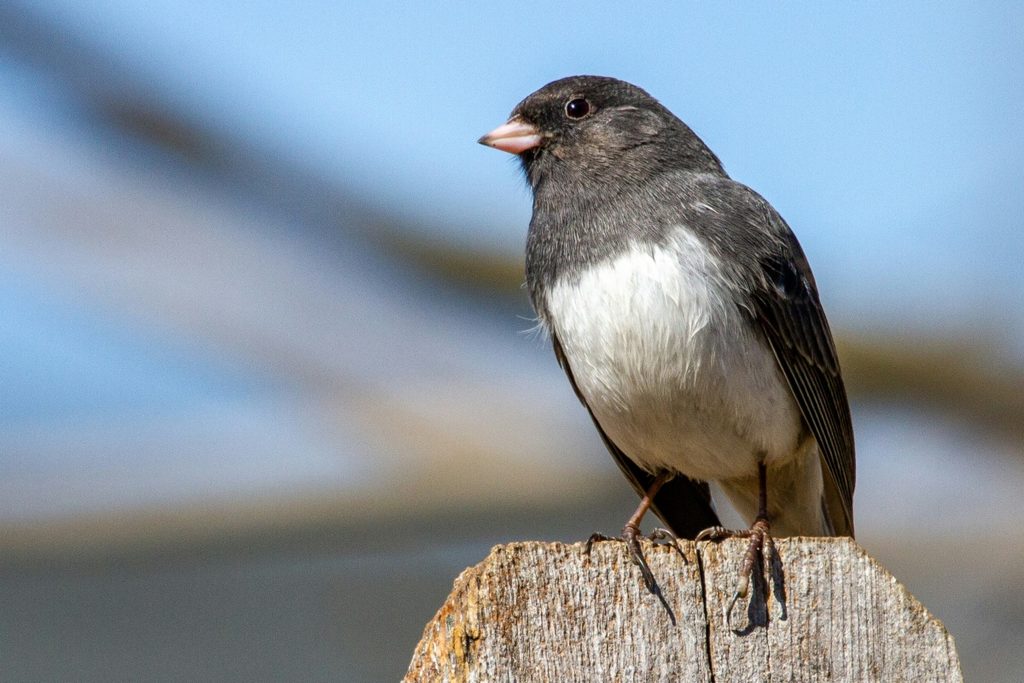
Dark-eyed juncos are the quintessential fall bird — and one of the hardest to photograph well. They’re small, fast, and constantly moving. Getting a sharp, well-composed photo takes patience and technique.
How to do it
- Scatter millet on a flat rock or stepping stone near your feeder. Juncos prefer ground feeding and will discover the rock quickly.
- Set up your camera 8–10 feet away on a tripod or stable surface. Use a long lens (200mm+) if you have one — even a phone camera with zoom works.
- Wait. Juncos are skittish but curious. They’ll approach the rock within 5–10 minutes if you stay still.
- Shoot in burst mode. Juncos move fast — capture 5–10 frames per approach and select the sharpest later.
What makes a great junco photo
- Eye contact. The best bird photos show the bird looking toward the camera. Wait for the moment the junco lifts its head and looks in your direction.
- Clean background. A blurred background (low f-stop or portrait mode) separates the bird from distracting elements.
- Natural light. Early morning light (7:00–9:00 AM) is warm and soft. Avoid harsh midday shadows.
For tips on attracting juncos specifically, see our how to attract juncos guide.
Challenge 3: Identify All Sparrows at Your Feeder
Difficulty: Hard
Time: All season
Best time: September–November
Sparrows are the most diverse, and most confusing — group of fall backyard birds. Five or more species can visit a single feeder, and telling them apart requires close observation.
The fall sparrow lineup
| Species | Key ID Feature | Feeding Behavior |
|---|---|---|
| Dark-eyed Junco | White tail flashes in flight, pink bill | Ground, under feeders |
| White-throated Sparrow | Bright yellow lores, white throat patch | Ground, hedgerow |
| Song Sparrow | Heavy breast streaking, central breast spot | Ground, low shrubs |
| Chipping Sparrow | Rusty cap, clean gray breast (fall: duller) | Ground, feeder |
| White-crowned Sparrow | Bold black-and-white head stripes | Ground, platform feeder |
How to tell them apart
- Start with size and shape. Juncos are small and round. White-throated sparrows are chunky. Song sparrows are medium with a long tail.
- Look for one field mark. Don’t try to memorize everything at once. Learn one diagnostic feature per species — like the junco’s white tail flash or the white-throated sparrow’s yellow lores.
- Use behavior as a clue. Juncos feed almost exclusively on the ground. White-throated sparrows stay in dense cover. Song sparrows are bold and often perch in the open.
Tools
- Merlin Bird ID app — free, uses sound and photos
- eBird — log your sightings and compare with local reports
For a complete sparrow identification guide with photos, see our fall sparrows and juncos ID guide.
Challenge 4: Create a Fall Yard List
Difficulty: Easy
Time: Ongoing through November
Best time: September 1 – November 30
A yard list is a running count of every bird species you identify in or from your yard. It’s the simplest birding challenge — and the most addictive.
How to do it
- Start a list on September 1. Use a notebook, a spreadsheet, or the eBird app (free).
- Record every new species with the date you first saw it.
- Include flyovers. A hawk soaring over your yard counts. A flock of geese flying south counts.
- Don’t count birds you can’t identify. “Probably a sparrow” doesn’t go on the list. If you’re unsure, take a photo or note the field marks and look it up later.
What a typical fall yard list looks like
Most backyards can accumulate 20–35 species between September and November, depending on location and habitat. Rural yards near forests or wetlands may hit 40–50. Urban yards typically reach 15–25.
The yard list effect
Once you start a list, you notice birds you’ve been ignoring for years. The crow flying over becomes a species entry. The flicker calling from across the street becomes worth walking outside for. A yard list turns your backyard into a birding destination.
Challenge 5: Listen for Owl Calls at Dusk
Difficulty: Medium
Time: 30 minutes
Best time: October–November, 6:00–7:30 PM
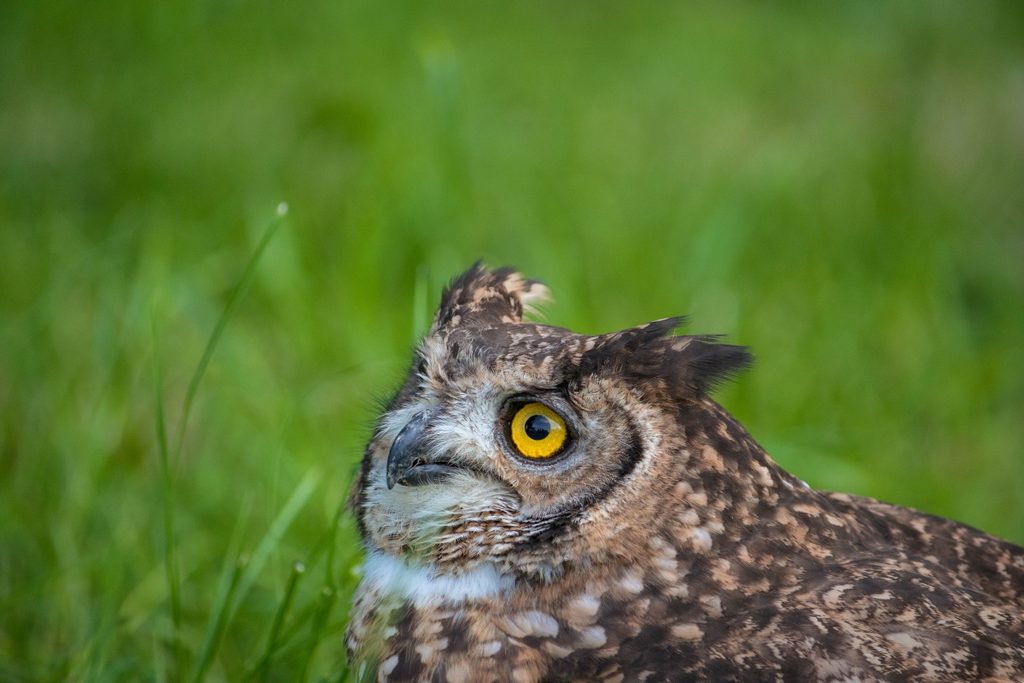
Fall is prime owl season. As temperatures drop, owls become more vocal — establishing territories, calling for mates, and hunting in the longer nights.
How to do it
- Go outside at dusk. 30 minutes after sunset is the sweet spot — too dark for most birds, just right for owls.
- Stand near trees. Owls roost in dense evergreens or tree cavities. Position yourself near mature trees, especially conifers.
- Listen. Don’t play owl calls on your phone (it stresses the birds). Just listen.
- Learn 3 calls. The “who cooks for you” of barred owls. The “whoo-whoo” of great horned owls. The high-pitched trill of eastern screech owls.
What you might hear
| Owl | Call | Likelihood |
|---|---|---|
| Barred Owl | “Who cooks for you? Who cooks for you-all?” | Common in wooded suburbs |
| Great Horned Owl | Deep “hoo-h’HOO-hoo-hoo” | Widespread, even in urban areas |
| Eastern Screech Owl | Descending whinny or steady trill | Common but easy to miss |
| Northern Saw-whet Owl | Repeated “too-too-too” (like a saw being sharpened) | Uncommon, mostly in migration |
For more backyard birding activities, see our fall birding tips for beginners.
Challenge 6: Find a Migrating Warbler
Difficulty: Hard
Time: 1–3 hours
Best time: September–early October
Warblers passing through in fall are harder to identify than spring warblers — they’re in dull “basic” plumage, not bright breeding colors. But finding one is a thrill that connects you to the vast movement of migration.
How to do it
- Focus on September. Most warblers pass through the northern US and Canada between late August and early October.
- Check trees near water. Warblers follow waterways during migration — a creek, pond, or even a birdbath can concentrate them.
- Look for mixed flocks. Fall warblers often travel with chickadees and kinglets. If you see a flock of small birds moving through trees, scan each bird carefully — one might be a warbler.
- Learn 3 fall warblers. Yellow-rumped warbler (yellow patches on sides and rump), palm warbler (bobs its tail constantly), and blackpoll warbler (streaky, with yellow feet).
Challenge 7: Create a Leaf Pile Bird Trap (Without the Trap)
Difficulty: Easy
Time: 10 minutes to build, days to enjoy
Best time: October–November
Instead of raking all your leaves to the curb, create a deliberate leaf pile near your feeder. Birds love it — and so will you.
Why it works
Leaf piles attract the exact species that visit yards in fall: sparrows, juncos, towhees, and wrens. They scratch through leaves for seeds, dormant insects, and other food. A leaf pile near your feeder creates a natural foraging zone that attracts ground-feeding species you’d otherwise miss.
How to do it
- Rake leaves into a loose pile (not packed tight) within 10 feet of your feeder.
- Scatter a handful of millet in and around the pile.
- Wait. Sparrows and juncos will discover it within 1–2 days.
- Don’t disturb it. Resist the urge to peek. Let birds feel safe in the pile.
For more ideas on making your garden bird-friendly, see our small garden changes birds notice immediately.
Challenge 8: Record the First Frost Bird
Difficulty: Easy
Time: 5 minutes
Best time: The first morning below 32°F
The first hard frost changes everything — insects die, natural food vanishes, and birds flock to feeders in numbers you haven’t seen since winter. Recording the first frost bird is a simple ritual that connects birding to the turning season.
How to do it
- Watch the weather forecast. When the first frost is predicted, set your alarm.
- Go outside at dawn. The first frost morning is usually clear, cold, and still.
- Note the first bird you see and hear. Write down the species, time, and behavior. Are they feeding more actively than usual? Are there more birds than yesterday?
- Add the date to your yard list. Over the years, you’ll build a personal phenology record — your own record of how the seasons shift.
Challenge 9: Host a Birding Brunch for Friends
Difficulty: Easy
Time: 2–3 hours
Best time: October (peak color, comfortable weather)
Birding is more fun with friends. Host a casual backyard brunch where the activity is watching birds — no expertise required.
How to do it
- Set up a viewing area. Place chairs facing your feeders. Put out blankets if the ground is dry.
- Provide binoculars and a field guide. Merlin Bird ID on a phone works great for beginners.
- Make it food-forward. The birds get suet and seed; your guests get coffee, pastries, and fruit. The brunch part is real.
- Play the “name that bird” game. See who can identify the most species in 30 minutes. Give a small prize — a bag of birdseed, a Kingsyard feeder, a field guide.
- Keep it short. 2 hours is perfect. Birds are most active in the morning, and brunch attention spans are limited.
Challenge 10: Photograph 5 Species in a Single Afternoon
Difficulty: Medium
Time: 2–3 hours
Best time: October, on a clear afternoon
This challenge combines patience, observation, and luck. Five species in one afternoon is achievable in most backyards — but it requires deliberate effort.
How to do it
- Choose your spot. Set up near your feeding station with a clear view of multiple feeders and the ground.
- Start at 2:00 PM. Birds feed actively in the afternoon as they prepare for the night.
- Wait for each species. Don’t chase birds — let them come to you. Most backyards attract 3–4 regular species within 30 minutes. The 5th requires patience or a different angle.
- Use the right settings. If you’re using a phone, tap on the bird to focus and expose. If you’re using a camera, set your shutter speed to 1/500 or faster to freeze motion.
Species to expect
| Time | Likely Species |
|---|---|
| 2:00–2:30 | Northern cardinal, house finch |
| 2:30–3:00 | Black-capped chickadee, tufted titmouse |
| 3:00–3:30 | Dark-eyed junco, white-breasted nuthatch |
| 3:30–4:00 | Downy woodpecker, blue jay |
| 4:00–5:00 | Any stragglers — check the ground for sparrows |
Track Your Progress
Create a simple checklist and post it on your refrigerator. Check off each challenge as you complete it. By November, you’ll have:
- Expanded your yard species list
- Learned to identify sparrows you’ve been ignoring
- Photographed birds you never thought you’d get close to
- Connected with the rhythm of the fall season
The best birding isn’t at a national park or a wildlife refuge. It’s in your backyard, with a cup of coffee, watching a junco you’ve seen a thousand times — and noticing something new.
Browse Kingsyard bird feeders and bird baths — designed to make your backyard the best birding spot on your block this fall.