Fall Sparrows and Juncos at Your Feeder: A Backyard Identification Guide
You glance out the kitchen window in mid-September and see a bird you don’t recognize. It’s small, brownish, and feeding on the ground beneath your platform feeder. Yesterday it wasn’t there. Today there are six of them.
Welcome to fall sparrow season.
Every year between September and November, billions of songbirds move south through North America. Among the most conspicuous arrivals at backyard feeders are the sparrows and juncos — a group of small, ground-feeding birds that spend summer in northern forests and arrive at feeders just as the weather turns. For many backyard birders, these unfamiliar visitors trigger the same question: What kind of bird is that?
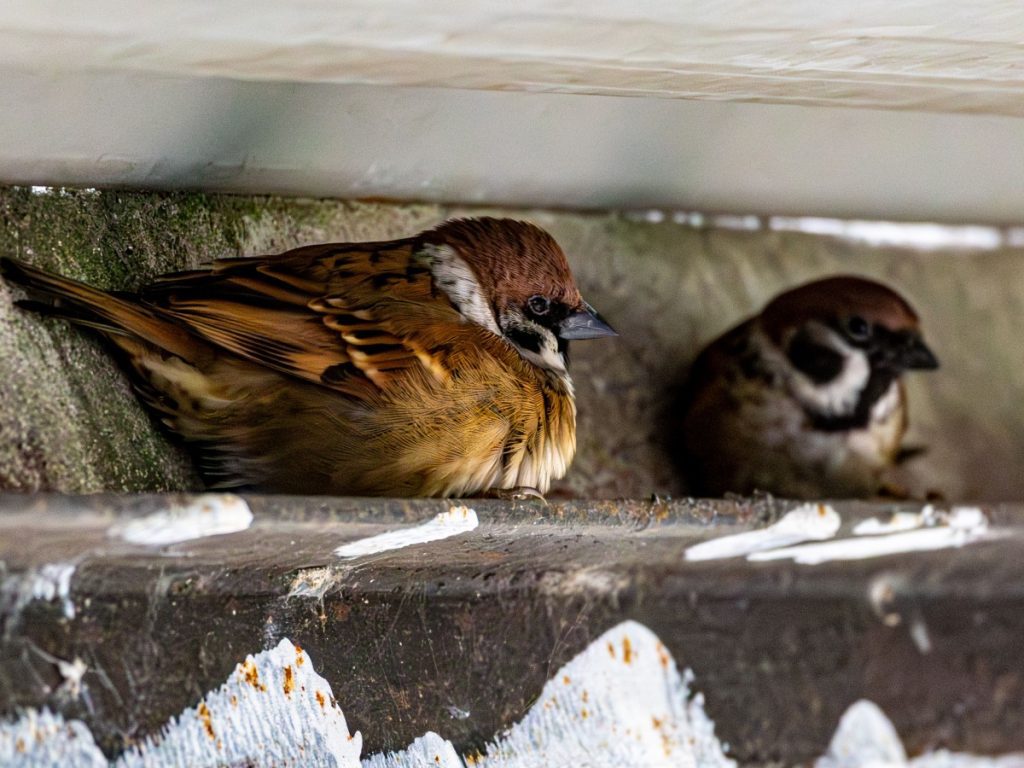
Sparrows are notoriously tricky to identify. They’re small, they move fast, and many species look similar at first glance — brown streaked bodies, small bills, quick movements. But each species has distinctive field marks that become easy to spot once you know what to look for.
This guide covers the 8 most common fall sparrows and juncos you’re likely to see at your backyard feeder this season. For each species, you’ll find the key field marks visible from your window, their feeding behavior, when they arrive, and what food attracts them.
Table of Contents
Why You’re Seeing New Birds at Your Feeder This Fall
If your feeder felt routine all summer — same cardinals, same chickadees, same house finches — fall changes the equation. Three things happen simultaneously in September and October:
1. Northern breeders move south. Species that spent summer nesting in Canada and the northern U.S. begin arriving in the mid-Atlantic, Midwest, and southern states. Juncos, white-throated sparrows, and fox sparrows are the most noticeable.
2. Local birds shift behavior. Species present year-round — like song sparrows and house finches — become more visible at feeders as natural seed and insect supplies decline. They’re not new; they’re just hungrier.
3. Mixed flocks form. Fall is flocking season. Sparrows, juncos, chickadees, and titmice travel together in loose mixed flocks, scratch-feeding through leaf litter. Where you see one, you’ll often see five or six.
According to the Cornell Lab of Ornithology, over 70% of North American bird species migrate, and fall migration is the larger movement — more birds move south in fall than return north in spring. Your backyard feeder is one stop on a continent-wide journey.
For a broader overview of what happens at your feeding station this season, see our fall migration feeder prep guide.
How to Identify Sparrows: What to Look For
Before diving into species, here’s a quick framework for identifying sparrows from your window:
Face pattern. The head is the most diagnostic part of a sparrow. Look for: bold stripes vs. plain face, colored patches (yellow, rusty, white), eye rings, and mustache stripes.
Breast pattern. Is the breast clean (plain) or streaked? Is there a central spot? Streaking pattern is one of the best ways to separate similar species.
Body size. Is it sparrow-sized (5–6 inches) or noticeably larger (7+ inches)? Fox sparrows are chunky; chipping sparrows are petite.
Tail behavior. Does it pump its tail? Flash white outer tail feathers? Juncos are famous for their white tail-flash in flight.
Feeding position. Is it on the ground, on a platform feeder, or perched in a shrub? Ground-feeding is typical for most sparrows, but some species visit elevated feeders more readily.
Behavior. Is it skulky and secretive (hiding in brush) or out in the open? White-throated sparrows are skulkers; juncos are relatively bold.
Dark-eyed Junco — The Bird That Says “Fall Is Here”
Scientific name: Junco hyemalis
Length: 5.5–6.3 in | Wingspan: 7.1–9.8 in
Arrival: September–October | Departure: March–April
The dark-eyed junco is the quintessential fall arrival. In much of the eastern U.S., its appearance at feeders in September or October is as reliable a sign of autumn as changing leaves. Birders sometimes call them “snowbirds” — a nickname that reflects their winter association.
How to identify
- Slate-gray hood covering head, chest, and upper back (in the common “Slate-colored” form)
- Clean white belly with a sharp boundary between gray and white
- White outer tail feathers that flash conspicuously in flight — this is the single best field mark
- Pale pinkish bill — small and conical
- Dark eyes (hence the name)
Females and immatures are browner and duller than adult males, but the white belly and tail flash are consistent across all plumages.
Feeding behavior
Juncos are almost exclusively ground feeders. They scratch-feed by hopping forward and kicking both feet backward simultaneously, scattering leaf litter to find seeds. They prefer open areas beneath feeders where they can see predators approaching.
What to feed them
Juncos love white millet and sunflower chips scattered on the ground or on a low platform feeder. They’ll also eat nyjer and cracked corn. If you rake a small clear area beneath your feeder, juncos will find it within days.
Fun fact
The junco’s white tail flash isn’t just pretty — it’s a communication signal. When a flock takes flight, the synchronized flash warns all members of potential danger simultaneously.
White-throated Sparrow — Bold Face, Shy Habits
Scientific name: Zonotrichia albicollis
Length: 6.3–7.1 in | Wingspan: 7.9–9.1 in
Arrival: September–November | Departure: April–May
The white-throated sparrow is one of the most distinctive fall sparrows — once you see the face pattern, you’ll never confuse it with anything else. It’s also one of the skulkiest, often staying hidden in brush piles and under shrubs before darting out to grab a seed.
How to identify
- Bold black-and-white head stripes — two white crown stripes bordered by black
- Yellow patches (lores) between the bill and eye — bright in spring, duller in fall, but always visible
- Clean white throat patch — the namesake feature, sharply contrasting with the gray breast
- Gray, unstreaked breast — smooth and plain, unlike streaked sparrows
- Brown upper back with dark streaks
There are two color morphs: “tan-striped” and “white-striped.” White-striped birds have bolder head patterns; tan-striped birds are subtler. Both have the yellow lores and white throat.
Feeding behavior
White-throated sparrows prefer to feed on the ground under dense cover. They’re slow, deliberate foragers — not as quick and scratchy as juncos. They often hang back at the edge of the feeder area, waiting for quieter moments.
What to feed them
White millet and black oil sunflower seeds scattered on the ground attract white-throated sparrows. A brush pile or dense shrub within 10–15 feet of the feeder gives them the cover they need to feel safe.
Fun fact
White-throated sparrows are famous in ornithology for a rare genetic system: about half of all individuals are “white-striped” and half are “tan-striped,” and they almost always mate with the opposite morph. It’s one of the closest things to a four-sex system found in vertebrates.
For tips on making your backyard more attractive to skulky species like this one, see our guide on small garden changes birds notice immediately.
Song Sparrow — The Year-Round Regular
Scientific name: Melospiza melodia
Length: 4.7–6.7 in | Wingspan: 7.1–9.4 in
Presence: Year-round (behavior shifts in fall)
The song sparrow is probably already in your yard — you just didn’t notice it much in summer when it was singing from a shrub. In fall, it becomes a more frequent feeder visitor as insect populations decline and the bird shifts to a seed-heavy diet.
How to identify
- Heavy brown streaking on the breast and flanks — the most streaked of the common feeder sparrows
- Central breast spot — a dark blotch in the middle of the chest, often the first thing you notice
- Rusty crown and gray eyebrow stripe (supercilium)
- Long, rounded tail — often pumped while foraging
- Brown overall with a warm, rufous tone
Song sparrows vary significantly by region — western birds are paler and grayer; eastern birds are warmer and more rufous. But the streaked breast with a central spot is consistent everywhere.
Feeding behavior
Song sparrows feed on the ground but are more willing than most sparrows to visit a low platform feeder. They scratch-feed like juncos but less aggressively. In fall, they often join mixed feeding flocks.
What to feed them
Song sparrows eat almost anything: black oil sunflower, millet, safflower, and even small amounts of cracked corn. A platform feeder with a seed mix is the easiest way to attract them.
Fox Sparrow — The Big Red Ground Feeder
Scientific name: Passerella iliaca
Length: 6.3–7.5 in | Wingspan: 10.6–11.8 in
Arrival: October–November (transient) | Departure: March–April
The fox sparrow is the largest and most striking of the fall sparrows — and one of the most transient. It passes through most of the eastern U.S. for only a few weeks in October and November, making each sighting a brief seasonal event.
How to identify
- Rusty-red overall — the entire head, back, wings, and tail are washed in warm rufous
- Heavy breast spotting — large, dark chevrons on a pale background, more spread out than a song sparrow’s streaking
- Large size — noticeably bigger than other sparrows; almost thrush-sized
- Thick, yellowish bill
- Kicks backward when feeding — a distinctive two-footed backward hop that scatters leaf litter
The fox sparrow’s size and color make it hard to confuse with other sparrows once you get a good look. The challenge is that it’s often hidden in leaf litter under dense brush.
Feeding behavior
Fox sparrows are vigorous scratch-feeders. They kick backward with both feet simultaneously, sending leaves flying in all directions. If you see a large sparrow-sized bird aggressively excavating your leaf litter, it’s almost certainly a fox sparrow.
What to feed them
Sunflower seeds and millet scattered on the ground near brush cover. Fox sparrows are shy and won’t visit feeders in the open — they need nearby cover.
Fun fact
The fox sparrow gets its name from the reddish color of the “Red” subspecies group, which resembles a red fox’s fur. Western populations come in gray, sooty, and slate-colored forms that look quite different.
Chipping Sparrow — From Rusty Cap to Winter Flocks
Scientific name: Spizella passerina
Length: 4.7–5.9 in | Wingspan: 8.3 in
Arrival: September–October (transient) | Departure: March–April
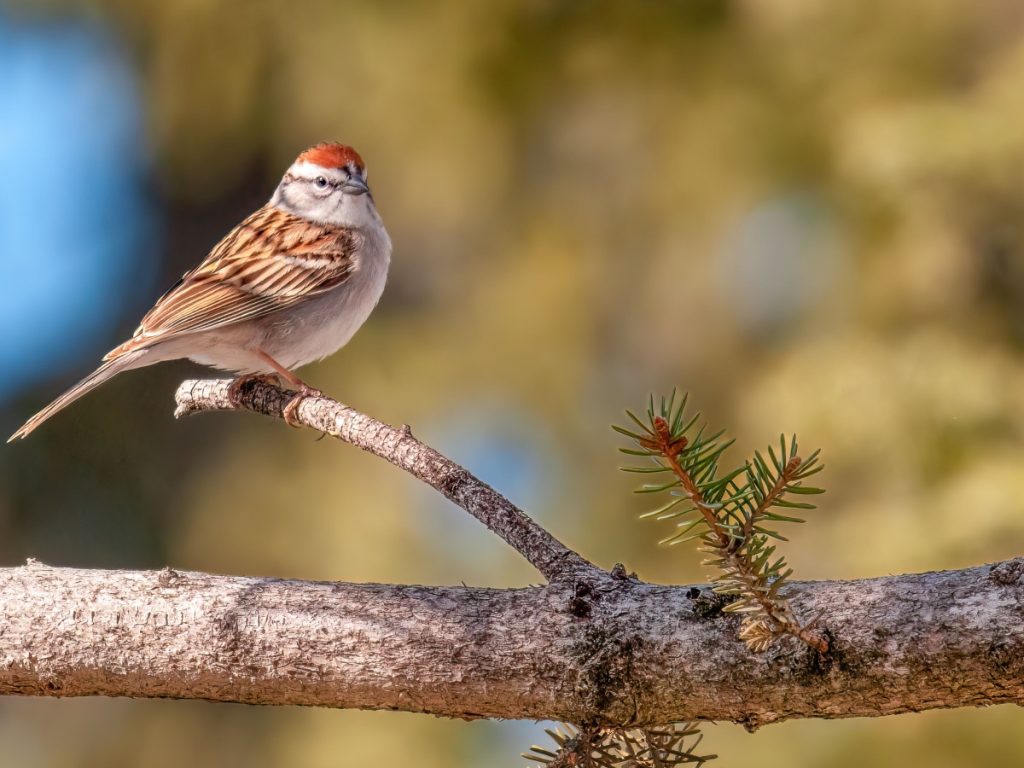
The chipping sparrow is one of the smallest and trimmest sparrows at the feeder. In summer, its bright rusty cap makes it easy to identify. In fall, the cap fades to a dull brown, and the bird joins mixed winter flocks that move through yards quickly.
How to identify
- Rusty cap (brighter in spring, duller in fall — but usually still visible)
- Clean, pale breast — no streaking at all
- Black eye line — thin but distinct
- Gray rump — visible when the bird flies away
- Slim, petite build — noticeably smaller and more delicate than other sparrows
Feeding behavior
Chipping sparrows feed on the ground in open areas and are relatively bold compared to other sparrows. In fall, they often travel in flocks of 10–30 birds that sweep through a yard and move on.
What to feed them
Millet and sunflower chips on the ground or in a low platform feeder. Chipping sparrows are small and have trouble handling large seeds.
White-crowned Sparrow — Striking and Cautious
Scientific name: Zonotrichia leucophrys
Length: 5.9–6.3 in | Wingspan: 8.3–9.4 in
Arrival: October–November | Departure: April–May
The white-crowned sparrow is one of the most visually striking fall sparrows — its bold black-and-white head stripes are impossible to miss. It’s also one of the most cautious, often watching from a distance before approaching the feeder.
How to identify
- Bold black-and-white crown stripes — four alternating stripes on the head (black-white-black-white)
- Clean gray breast — no streaking, smooth and plain
- Pink or yellowish-orange bill — varies by subspecies
- Gray face and nape — no yellow lores (unlike white-throated sparrow)
- Brown, streaked back
The key difference from the white-throated sparrow: white-crowned sparrows have no yellow on the face and a clean gray breast (not a white throat patch).
Feeding behavior
White-crowned sparrows are skulky and prefer to feed near cover. They’re slower and more deliberate than juncos, often pausing to look around between seeds. They visit ground feeding areas and low platform feeders.
What to feed them
Millet, black oil sunflower, and safflower near brush cover. Like most skulky sparrows, they won’t feed in the open if they can avoid it.
Fun fact
White-crowned sparrows are one of the most studied birds in North America. Their song varies by regional “dialect” — a bird from California sounds different from one in Montana. Researchers have used this variation to study bird song learning for decades.
American Tree Sparrow — The Winter Visitor
Scientific name: Spizelloides arborea
Length: 5.5–6.3 in | Wingspan: 9.4 in
Arrival: Late October–November | Departure: March–April
The American tree sparrow is a true winter specialist — it arrives late in fall and stays through the coldest months. Despite its name, it feeds almost entirely on the ground, often in weedy fields and backyard feeding stations.
How to identify
- Bicolored bill — dark upper mandible, yellow lower mandible (unique among common sparrows)
- Rusty cap and eyeline — a chestnut-red patch on top of the head and a line through the eye
- Dark central breast spot — smaller and more discrete than a song sparrow’s spot
- Gray face and upper breast — smooth, unstreaked
- Brown, streaked back with a gray rump
The bicolored bill is the easiest field mark — if you see a small sparrow with a half-dark, half-yellow bill, it’s an American tree sparrow.
Feeding behavior
American tree sparrows are ground feeders that often gather in small flocks. They’re relatively tolerant of other species and will feed alongside juncos and house finches without conflict.
What to feed them
Millet, sunflower chips, and nyjer on the ground or in low platform feeders. They have small bills and prefer smaller seeds.
House Finch — The Red Bird That Isn’t a Cardinal
Scientific name: Haemorhous mexicanus
Length: 5.1–5.5 in | Wingspan: 7.9–9.8 in
Presence: Year-round (more visible in fall)
The house finch isn’t a sparrow, but it’s often grouped with them because of its similar size, shape, and feeding behavior. In fall, house finches become much more visible at feeders — and the males’ red plumage often causes confusion with cardinals, especially at a distance.
How to identify
Males:
- Red forehead, eyebrow, and throat — the red varies from deep crimson to orange or even yellow
- Brown-streaked flanks and belly — streaking is finer and less heavy than a song sparrow’s
- Notched tail — distinctly forked when fanned
Females:
- Plain grayish-brown overall — no red at all
- Blurred streaking on the breast — less crisp than a song sparrow’s
- Notched tail — same forked shape as the male
Feeding behavior
House finches are the most versatile of the group. They’ll feed on the ground, on platform feeders, and readily visit tube feeders with perches. They’re gregarious and often feed in flocks of 10–20 birds.
What to feed them
Black oil sunflower and nyjer in tube feeders. House finches are one of the few fall visitors that readily use elevated tube feeders rather than insisting on ground feeding.
Fun fact
House finches were originally native to the western U.S. In 1940, a small group was released on Long Island, New York — likely from illegal pet trade stock. Those few birds colonized the entire eastern U.S. within 50 years, making the house finch one of the most successful invasive species stories in North American birding.
What to Feed Fall Sparrows and Juncos
Different species prefer different seeds, but there’s a simple formula that attracts the widest range of fall sparrows. (For the full seasonal feeding strategy from summer through fall, see our August bird feeding guide.)
| Seed | Best For | Feeder Type |
|---|---|---|
| White millet | Juncos, white-throated sparrows, chipping sparrows, tree sparrows | Ground or platform |
| Black oil sunflower | Song sparrows, white-crowned sparrows, fox sparrows, house finches | Platform or tube |
| Safflower | Cardinals, house finches, white-crowned sparrows | Platform or tube |
| Nyjer (thistle) | Goldfinches, pine siskins, American tree sparrows | Tube feeder |
| Sunflower chips | All small sparrows (easier for small bills) | Ground or platform |
Key principle: Scatter a handful of millet on the ground beneath your feeder every morning. This single habit will attract more sparrow species than any other feeder change. Ground feeding is the default for most fall sparrows — they won’t visit a hanging tube feeder until they’ve been coming to your yard for weeks.
For a complete guide to choosing the right seed for fall and winter, see our bird seed for fall and winter guide.
Fall Sparrow and Junco FAQs
Why are there new birds at my feeder in September?
Fall migration brings billions of birds south through North America between August and November. Species that bred in Canada and the northern U.S. — especially sparrows and juncos — arrive in the mid-Atlantic, Midwest, and South in September and October. Your feeder becomes a refueling stop on their journey.
How do I tell sparrows apart?
Focus on four features: face pattern (striped or plain?), breast pattern (streaked or clean?), body size, and tail behavior. The dark-eyed junco has a gray hood and white tail flash. The white-throated sparrow has bold face stripes and yellow lores. The song sparrow has heavy breast streaking with a central spot. Start with these three and add species as you gain experience.
What is the gray bird that flashes white tail feathers?
That’s a dark-eyed junco. The white outer tail feathers are the junco’s most distinctive field mark — visible every time the bird takes flight. Juncos arrive at feeders in September or October across most of the eastern U.S. and stay through early spring.
What food attracts the most fall sparrows?
White millet scattered on the ground attracts the widest range of fall sparrows. Juncos, white-throated sparrows, chipping sparrows, and song sparrows all prefer ground feeding with small seeds. Add black oil sunflower on a platform feeder for larger species like white-crowned sparrows and fox sparrows.
Do sparrows eat from tube feeders?
Most sparrows prefer ground or platform feeders. House finches are the exception — they readily visit tube feeders with perches. If you want to attract sparrows, a low platform feeder or a cleared ground area beneath your existing feeder is far more effective than a hanging tube feeder.
When do juncos arrive in fall?
Juncos typically arrive in the mid-Atlantic and Midwest between mid-September and mid-October. In the South, they may not appear until November. In most areas, the first junco sighting of the fall is one of the most reliable seasonal markers for backyard birders.
Are house finches the same as purple finches?
No, but they’re commonly confused. Male house finches have red on the head and throat with brown-streaked flanks. Male purple finches are raspberry-red across the entire head, back, and breast with less streaking. Female house finches have blurred breast streaking; female purple finches have sharper streaking and a more prominent face pattern.
Start Watching This Week
You don’t need binoculars, a field guide, or a birding app to start identifying fall sparrows (though all three help). You just need a clean feeder, fresh seed on the ground, and five minutes at the window.
Three things to do right now:
- Scatter millet on the ground beneath your feeder each morning. This is the single highest-impact change for attracting fall sparrows.
- Watch for the white tail flash. If you see it, you’ve found your first junco of the season.
- Look at faces, not bodies. Sparrow bodies all look brown. Faces tell you the species.
Fall sparrow season is the backyard birder’s most rewarding identification challenge. The birds are beautiful, the behaviors are fascinating, and the variety — from the bold junco to the secretive fox sparrow — keeps every feeding session interesting.
Browse Kingsyard platform feeders and bird baths designed to attract ground-feeding species — built to bring fall sparrows and juncos closer to your window.